The mines of the future are in American junk drawers and IT storage rooms, yet ironically the U.S. is reliant on foreign production for the majority of refined rare earth elements (REEs.) U.S. production is trying to catch up. Recently, CHIPS Act federal investment has marked a shift from research to industrial scale production with 1.6 billion in funding and loans for USA Rare Earth and a $400M equity stake in MP Materials, but the underlying problem has a long history. A 2010 supply crunch led to the Department of Energy’s Assessment of the Feasibility of Recovering Rare Earth Elements program, and work has continued to identify ways to secure these critical minerals.
In December 2025, funding of $134 million was announced for enhancing domestic supply chains of REEs from unconventional feedstocks, including e-waste. High-tech devices contain many concentrated critical minerals, but turning to e-scrap as a source for these elements presents challenges. For the U.S. to achieve federal objectives and independence, the recycling industry must evolve and innovate beyond collection to a greater level of refining.
The “Rare” Myth
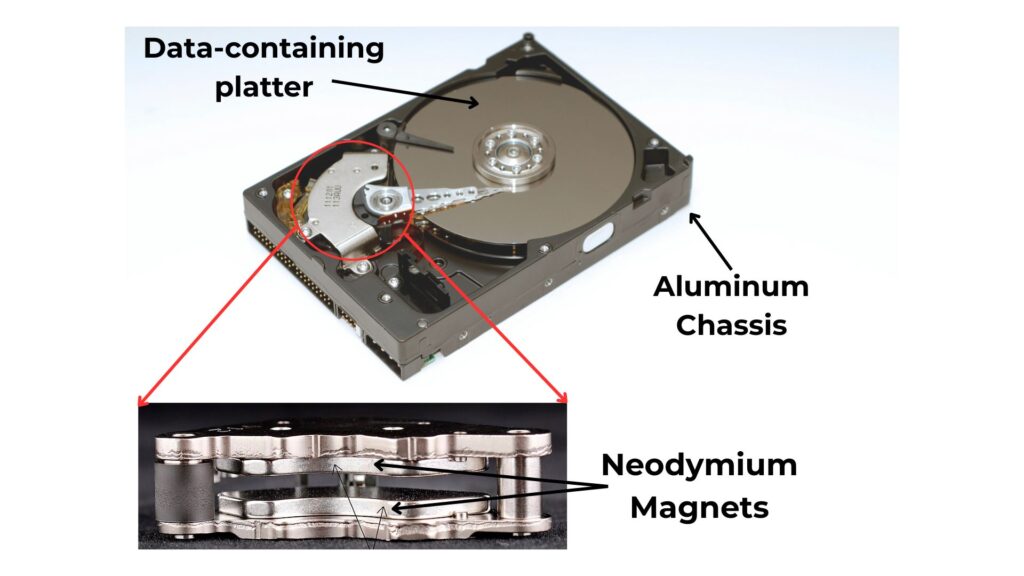
REEs are not rare despite the name, but instead difficult to refine. They are not often found in high purity deposits in nature. In contrast, e-waste often contains components that make them a veritable “urban ore” for REEs. Take for example the magnets in hard drives and other electronics that can be up to 22-32% Neodymium with Praseodymium and Dysprosium in significant concentrations. The difficulty then isn’t just finding these components in waste, but effectively liberating them from the complex assemblies and alloys that contain them.
Why most recycling fails REEs
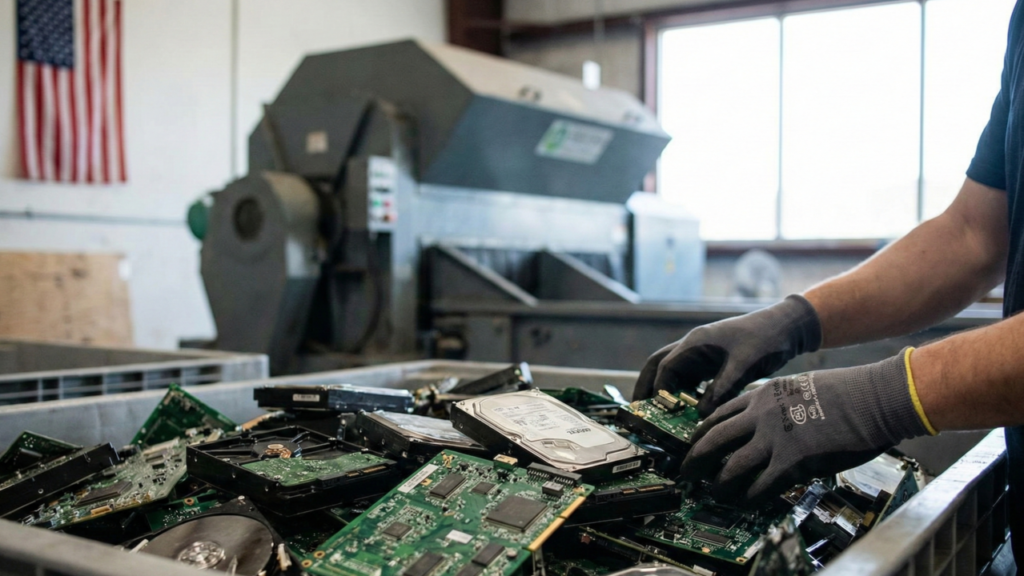
Recovering these metals and elements from e-waste isn’t much easier than it is from natural materials, typically electronics are shredded, and the shred is sorted in a few different ways to produce Ferrous, non-ferrous, plastic, and circuit board portions. The refining process that follows is usually optimized for metals that are relatively plentiful in these shred outputs, like copper, steel, aluminum, and precious metals like gold. With the typical pyrometallurgical process, the high heat is fine for metals with a low oxygen affinity like gold and copper. REEs, on the other hand, instantly oxidize and migrate into the slag where they are usually lost. Refining this way usually produces just a few clean metals and it can be prohibitively difficult to separate REEs from the other resulting products that they are blended or alloyed with. Advances in technology, including hydrometallurgy and bio-leaching, avoid this with chemical extraction or room temperature processes. These promise to provide new methods for recycling REEs from waste rather than relying on virgin materials, but there are a few key challenges to overcome for these to be a viable alternative.
Adapting recycling methods
Component-level separation is an area of innovation that will aid in recovering REEs because concentrations of specific elements will be greater and optimize the refining process used. More targeted disassembly can be achieved with robotics or harmonic vibration for hard drive disassembly. Instead of searching for a needle in a haystack, one might remove the needles before they end up mixed with hay. These technologies are quickly emerging and will enable better separation. The economics of refining REEs will be far more attractive when concentrations are higher from component-level separation, however, for this to support a secure U.S. supply chain there must be domestic recycling and refining.
The Export Crisis
U.S.-based recycling doesn’t create a circular supply chain for domestic resilience if the devices are shipped overseas for processing. According to a Basel Action Network report in 2025, roughly 33,000 metric tons of used electronics leave US ports every month. This profitable trade keeps strategic inventory under foreign control and is essentially exporting national security.
An increased focus on component-level separation and U.S.-based recovery of REEs from e-scrap can diversify supply and reduce reliance on foreign production. A domestic supply isolated from economic shocks and crises has the potential to bolster DoD Mine-to-Magnet initiatives and support the next generation of American made semiconductors and hardware.